Sunday, 10 June 2012

15, months old Syria Conflict .

           Russia   should   do  balance  the   power   struggling  in  Syria  to   prevent  incidence  of   another  Lipya  .   Mr.  Putin  rejected  suggestion  that  international  sanction  or  some  form  of   military   intervention  -even  outside   the   U.N.   to   resolve  15  months   old  conflict  .   It  was   necessary   for  the  U.N  's   searching  the   solution  of   Syria   conflict  .  
Simply naming a Kurdish leader may not be enough for the SNC to rally the support of many minorities. Among Kurds in Syria, even those who welcomed the move acknowledged its limitations, given the splits among the opposition and divisions within the Syrian Kurdish community.
"This affirms Kurdish identity but not much will change," said Ahmed Mousa, an activist from the northern Syrian Kurdish city of Qamishli. "Kurds won't step in front of the cannon unless they get guarantees endorsed by the international community."
Abdul-Hakim Bachar, a leading member of the Kurdish National Council, an umbrella group of nearly a dozen Syrian Kurd opposition parties that was formed in October, said there "must be a pact that safeguards the rights of all components of the Syrian nation and offers them guarantees that change is in their interest."
"Barring this, most of the components—Alawites, Druze, Ismailis, Christians and some Kurds—will remain on the sidelines of the revolution," he says. Together those groups make up between 35% and 40% of Syria's population of about 22.5 million, according to estimates by various United Nations agencies.
The Kurds are an especially large and important minority. They have long been treated as second-class, and the regime has denied many citizenship.
In the wake of the uprising, President Assad offered Kurds citizenship and other benefits. While few have become ardent backers of the regime, the group has remained divided, and Kurds haven't joined the rebellion in the large numbers opponents of the regime had hoped for.
The SNC's election of Mr. Sieda as its new leader was an apparent appeal to minorities. The 56-year-old academic was the only contender for the post, which he will hold for three months before another election is held.
Burhan Ghalioun, a secular Sunni academic based in Paris, resigned three weeks ago over criticism that the council wasn't working transparently and that it had grown out of touch with the protest movement inside Syria. For months, protesters have criticized the group's leaders—most of whom have lived in exile for many years—for neglecting basic requests from inside Syria for funds, aid, and arms as they jockeyed for political positions. Western nations trying to shape the council into a transitional body have stressed the need to make it more inclusive to a broader range of Syrians.
The SNC was born of a power-sharing agreement between Syria's most powerful exiled opposition faction, the Syrian Muslim Brotherhood, and secular groups, grass-roots activists, and independent opposition leaders from religious or ethnic minorities, like Mr. Sieda.
Some activists were quick to point out that Mr. Sieda shares many of the weaknesses that eventually discredited Mr. Ghalioun's leadership, which was seen as a superficial front to a council dominated by heavyweight political players including the Brotherhood.
Mr. Sieda—who is Sunni Muslim as well as ethnic Kurdish—has been based in Sweden for much of the two decades he has lived outside Syria. He is not an influential leader within the Kurdish community, observers say, but is seen as the only candidate the divided SNC could agree on. A push behind a Christian candidate failed largely due to objections from Islamists on the council.

Thursday, 7 June 2012

Be Patient !

Panetta said he wants to get an assessment of the situation from the top U.S. commander, Marine Gen. John Allen, and see how confident he is about NATO’s ability to confront the threats both from the Taliban and the Haqqani network.
“I think it’s important to make sure we are aware of the kind of attacks they’re going to engage in … as we go through the rest of the summer,” Panetta told reporters traveling with him during a stop in New Delhi, India, on Wednesday.
Speaking to troops gathered Thursday at the airport in Kabul, Panetta kept up the drumbeat on Pakistan that began during his visit to India. Panetta told the troops that “we have every responsibility to defend ourselves and we are going to make very clear that we are prepared to take them on and we’ve got to put pressure on Pakistan to take them on as well.”
Panetta spoke in Kabul just a day after three suicide attackers blew themselves up in a marketplace in southern Afghanistan, killing 22 people and wounding at least 50 others. In the east, meanwhile, Afghan officials and residents said a pre-dawn NATO airstrike targeting militants killed civilians celebrating a wedding, including women and children. A NATO forces spokesman said the coalition had no reports of civilians being killed in a raid, but was investigating the allegations of civilian casualties.
Allen has to withdraw 23,000 American troops by the end of September, leaving about 68,000 U.S. military personnel in the country. Officials have said the bulk of the 23,000 probably will not come out until shortly before the deadline.
As those troops leave, Allen has said that Afghan forces will be used to fill in the gaps in the eastern and southwestern parts of the country. They will be buttressed by U.S. advisory teams that will work with the Afghan units.
Once the 23,000 U.S. troops depart, Allen is expected to review how the fighting season is going and then will begin to put together an analysis for President Barack Obama on how troop withdrawals will proceed next year.
The defense secretary also joked with troops at the Kabul airport about the U.S. strike that killed an al Qaeda leader Monday, saying, “the worst job you can get these days is to be a deputy leader in al Qaeda, or for that matter a leader”

Tuesday, 5 June 2012

Panetta visits Vietnam .

"Deliberate emphasis on military and security agendas, and strengthening military deployment and alliances are not in step with the times," he said.
Obama announced the shift to a Pacific focus during a tour of Asian countries in November.
The announcement came against a backdrop of reduced defense spending as the United States was dealing with economic issues at home, preparing to pull out of Iraq and contemplating the end of warfare in Afghanistan.
"As we end today's wars, I have directed my national security team to make our presence and missions in the Asia Pacific a top priority," Obama said in a November 17 speech in Australia. "As a result, reductions in U.S. defense spending will not -- I repeat, will not -- come at the expense of the Asia Pacific."
At the time, Obama announced plans for the United States to station up to 2,500 Marines in Australia in the coming years.
Panetta is on an eight-day trip through the region explaining the U.S. policy, and seeking to increase military ties with regional allies. He said the shift is not a threat to China and its growing military power.
"I reject that view entirely," Panetta said. "Indeed, increased U.S. involvement in this region will benefit China."
He also rejected arguments that helping U.S. allies in the region militarily is an invitation to greater tensions.
"I don't think we should take the attitude that just because we improve their capabilities that we are asking for more trouble," he said.
Panetta said the United States will work to improve communication with China with an aim to "build trust" between the two nations, and he emphasized diplomatic approaches to promoting open commerce and freedom of the seas.
A key issue in the region is the conflict between China and various regional nations -- such as the Philippines, Vietnam, Brunei, Malaysia and Taiwan -- over the South China Sea.
The area, nicknamed "the second Persian Gulf" because of its potential for massive oil and gas reserves, is also a key passageway for the world's oil and is home to enormously valuable fisheries.
A crisis in the area has the potential for major economic damage to the United States as well. As one of the busiest sea lanes in the world, disputes in the South China Sea could have a major impact on shipping by forcing costly rerouting.
According to estimates by the Center for Strategic and International Studies, $5.3 trillion worth of trade goods pass through the South China Sea each year; U.S. trade goods account for $1.2 trillion

U.S. defence secretary brgins India visit .

US Defence Secretary Leon Panetta has arrived in India to hold talks on the new US strategic focus on Asia.
Mr Panetta will hold talks with PM Manmohan Singh on the opening day of his two-day visit to India.
Last November, President Barack Obama announced that the Asia-Pacific region was a "top priority" for US security policy.
His comments were seen as a challenge to China, which is striving to be the main regional power.
Mr Panetta is expected to hold talks to boost military ties between India and US.
He is also expected to discuss the Nato-led war effort in Afghanistan and China's growing economic and military powers in the region.
Mr Panetta will meet Defence Minister AK Antony and National Security Adviser Shiv Shankar Menon during his visit.
The AFP news agency quoted anonymous American officials as saying that India and US shared similar interests and concerns over China as well as threats posed by extremists.
"Strategically, we see India as a partner with a lot of common interests," a senior defence official said.
Mr Panetta is on a nine-day tour of Asia which has included visits to Vietnam and Singapore.
Correspondents say the tour is an attempt to shore-up American power in the Asia-Pacific region in the face of growing Chinese influence.

More on This Story

Related Stories

The U.S.'s Pressure in Asia . ...

                          The  U.S.   should  put   pressure   on   China  ,  using   three   corcing  force  :       1.  The   Trade   Barrier  ,    2.  The  Human   Rights  Complaint  .   3.  The  Military   Strategic  Shift   to   Asia  .  China  should   be   careful  to  face  the   U.S.'s   pressure  .   
Trade barriers are government-induced restrictions on international trade.[1] The barriers can take many forms, including the following:
Most trade barriers work on the same principle: the imposition of some sort of cost on trade that raises the price of the traded products. If two or more nations repeatedly use trade barriers against each other, then a trade war results.
Economists generally agree that trade barriers are detrimental and decrease overall economic efficiency, this can be explained by the theory of comparative advantage. In theory, free trade involves the removal of all such barriers, except perhaps those considered necessary for health or national security. In practice, however, even those countries promoting free trade heavily subsidize certain industries, such as agriculture and steel.
Trade barriers are often criticized for the effect they have on the developing world. Because rich-country players call most of the shots and set trade policies, goods such as crops that developing countries are best at producing still face high barriers. Trade barriers such as taxes on food imports or subsidies for farmers in developed economies lead to overproduction and dumping on world markets, thus lowering prices and hurting poor-country farmers. Tariffs also tend to be anti-poor, with low rates for raw commodities and high rates for labor-intensive processed goods. The Commitment to Development Index measures the effect that rich country trade policies actually have on the developing world.
Another negative aspect of trade barriers is that it would cause a limited choice of products and would therefore force customers to pay higher prices and accept inferior quality.[3]

Monday, 4 June 2012

Fearing Harm to Myanmar Ties .

It   is  first   issue  for   Daw  SUU  !  
an adviser to Myanmar’s president criticized her for lacking “transparency” in carrying out her trip and for her comments warning international investors against “reckless optimism” about Myanmar.
“Personally, I really admire her, but I have a doubt,” the adviser, U Nay Zin Latt, said in an e-mail. Public criticism of Ms. Aung San Suu Kyi, even in its mildest forms, is rare, partly because she is such a popular figure in the country.
Mr. Nay Zin Latt’s comments were the first by one of President Thein Sein’s advisers — who serve as spokesmen — since the president canceled a trip to Thailand on Friday. The Thai news media are portraying the cancellation as a reaction to Bangkok’s handling of Ms. Aung San Suu Kyi’s visit.
The fact that Ms. Aung San Suu Kyi was allowed back into the country on Sunday was a milestone on Myanmar’s road to national reconciliation. During the periods when she was not under house arrest in the past two decades, she chose not to travel abroad for fear of being denied re-entry by Myanmar’s military rulers.
Yet the discontent over her six-day visit to neighboring Thailand underlines the fragility of her country’s transition.
The complicated and delicate relationship between the president and Ms. Aung San Suu Kyi, a newly elected lawmaker, is in some ways the bedrock of the current reform process in Myanmar, formerly known as Burma. Their meeting in August accelerated the changes sweeping the country and helped persuade Ms. Aung San Suu Kyi to rejoin the political system.
“Most of the improvements in Burma these days are because of the relationship between Thein Sein and Aung San Suu Kyi,” said Win Min, a senior researcher at the Vahu Development Institute, an organization set up by Harvard-trained Burmese exiles that studies issues related to Myanmar. “I’m a little bit worried about their personal relations,” Mr. Win Min said. “If this relationship is strained, it could hurt national reconciliation.”
The abrupt cancellation on Friday of Mr. Thein Sein’s visit to Thailand appears to have been a message to Bangkok — and other governments across the region — that Myanmar’s leader will not tolerate being overshadowed by Ms. Aung San Suu Kyi’s star power

A few word to Daw Aung San Suu Kyi .

                    Hello !   Daw  Aung  Suu  Kyi  !  ,   I   have   some  Suggestions   for   you  :
                   1.  You   should  try   to   be   a  politician  but   not  to  be  a   university   lecturer  .
                   2.   Almost   of   all  your  speeches   were  only  lectures  but  not  political-means   to  change  the   Burma  (Myanmar )   as   a  democratic   Country  . 
                  3.   HOW   about   your  National  Reconcilation  Road  Map  ,  after  you   became  a  legal  parliamentarian .  Please!   reconfirm  your   political  life  . 
                 4. Democratic  System   should  have    transparent  over  view  or  planning  . 
                 5.  Please!   don't  speak  with  much   lateral  mianning  or  only   popular  words  to   the  public  .  
                 

Sunday, 3 June 2012

Hosni Mubarak is sentenced to life in prison .

                           It   is   neither  the   end   of   an   autocrae  nor   the   struggling  of   between  the   two  Presidential   Candidates  but   a   step of  changing  process  lightinning  .  Don't   forget  the   relation  of   the   U.S.A.  ,   the   strongest  power   in   every  region  !   Only   the   unity   of   people  power  should   find  out  the   solution  .  
                            
Activists said the verdicts mean that no one has been held directly accountable for killing the nearly 1,000 people who died during the revolt. Mubarak and former interior minister Habib al-Adli were convicted for failing to stop the killings, not for ordering them. “Both will appeal,” said Yusry Abdel Razak, one of Mubarak’s attorneys.
The long-awaited verdicts jolted Egypt’s presidential race, as Mohamed Morsi, the Muslim Brotherhood candidate who will compete in a runoff this month, sought to take advantage of the new groundswell of revolutionary rage to attack his opponent, Mubarak-era prime minister Ahmed Shafiq.
As the sun set in Cairo, thousands of Egyptians poured into Tahrir Square and into the streets of the Mediterranean port of Alexandria and other cities. The volume and vigor of the turnout were startling in a year in which revolutionaries have often appeared deflated and rudderless.
“All of this is a charade, and we don’t accept it,” said Amal Ramsis, 40, as she protested in the square.
Dissatisfaction with the ruling could push revolutionaries who had planned to boycott the runoff election for president into grudging support of Morsi, an uncharismatic conservative Islamist, experts said.
“The Brotherhood might be able to capitalize on this to push the line for revolutionary unity against the regime,” said Michael Wahid Hanna, an Egypt analyst at the Century Foundation. “The anger could push those planning to sit it out to cast a vote for the Brotherhood against the old regime.”
After the verdict was handed down, Mubarak was whisked away on a helicopter to the Tora Prison hospital in suburban Cairo. The former strongman reportedly suffered a heart attack after learning that he would not be returned to the military hospital where he has been held in recent months, according to a medical official who spoke on the condition of anonymity. As the aircraft touched down, Mubarak reportedly wept and refused for several minutes to debark. State media reported he was in stable condition Saturday night in the prison.
The decision marked the first time that Mubarak has entered a prison since his detention in April 2011. During that time, he has been housed at a military hospital.
The three-judge panel that presided over the landmark case cited a statute of limitations in acquitting the former president, his two sons and a business tycoon of corruption charges. Both Alaa Mubarak and Gamal Mubarak will remain in custody on separate charges of stock market fraud.


Thursday, 31 May 2012

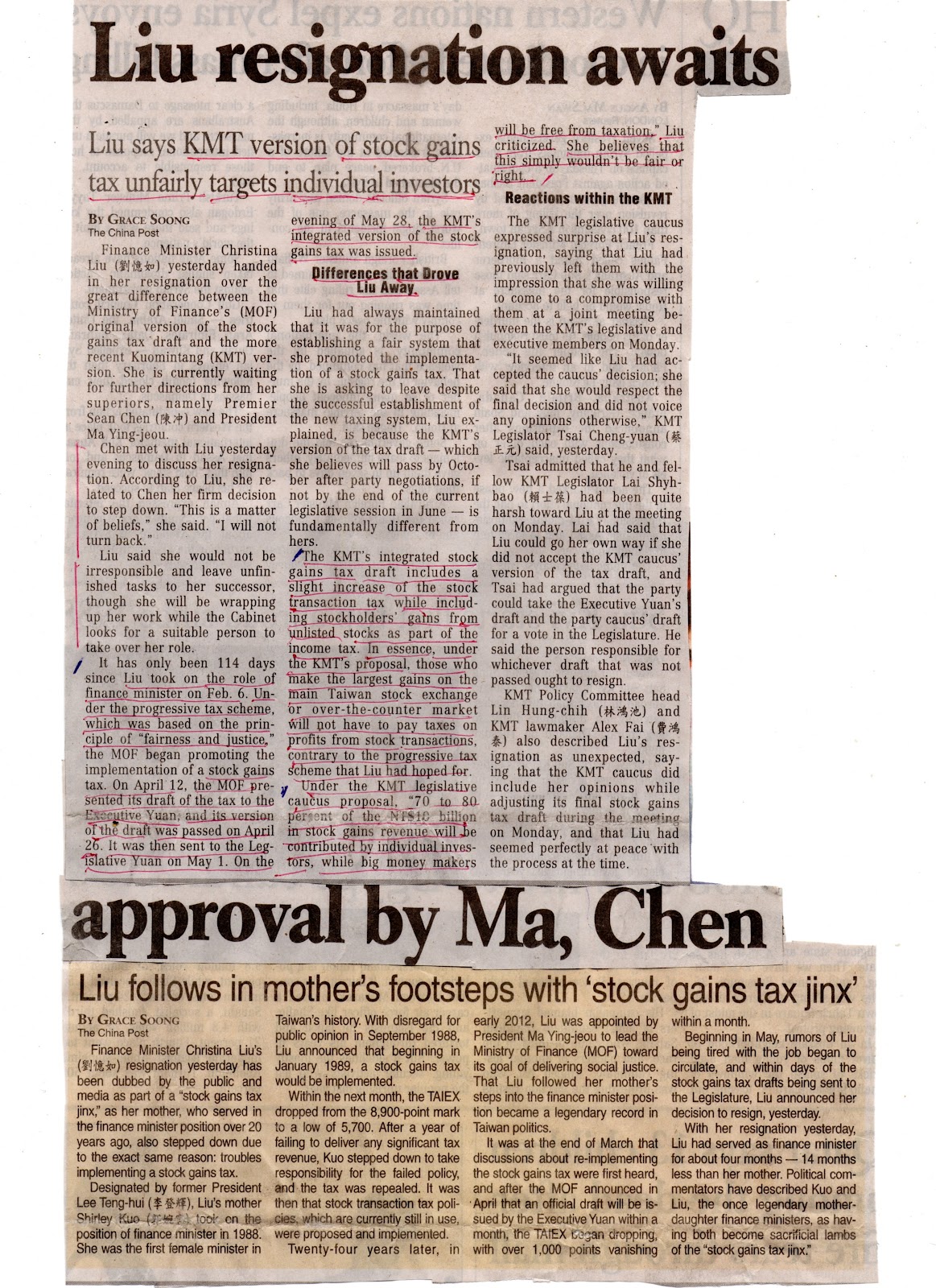
The Resignation of Finance Minister ,Christina Liu.

                      THE   SHOW-DOWN   of   the   morality  of   the  Legislative  Yuan  and  the  Executive  Yuan  or   the   effect   of   the  struggling   between  the   Executive  and   the  Legislative  Yuans  .  
                        Don't   touch   the  Capital   Gains   Tax  Law  ,   Mr.  New   Finance   Minister   !   The   version of  Capital      Gains  Tax  DRAFT  by   K.M.T.   Legislators  group  ,   will  make  Insider   Trading   .  Think   Clearly  and   Do   Clearly  !   God   bless   with  you   !  
Despite a dispute that has lasted for nearly two months, various relevant authorities have been unable to reach a consensus on a plan to impose a capital gains tax on stock investments. Instead, they are becoming increasingly divisive on the issue. The Cabinet should withdraw a version of the plan it previously submitted to the Legislature and should allow the next finance minister to draft a new one. Over the past month, the proposal by former Finance Minister Christina Liu has not only failed to convince the public, but legislators from the ruling Kuomintang have also abandoned her one after another, prompting her to resign as a result. The incident has impacted the credibility of President Ma Ying-jeou and the morale of his administration. Working under a severe time constraint, the KMT legislative caucus presented earlier this week an integrated version of the plan that combines different ideas put forth by its legislators. This version, which would offer the option of paying a stock transaction tax of between 0.02 percent and 0.06 percent in place of a capital gains tax, is realistic. It is not, however, in line with the principles of fairness, justice and taxing people according to their ability to pay. Instead of pushing through the plan in a hurry, the Cabinet should retract it for further consideration and allow the dispute to gradually calm down. (Editorial abstract -- May 31, 2012) (By Y.F. Low)

Tuesday, 29 May 2012

Syria Crisis Deepen in divisions .

                          It  presents  a  complicated   political  problem  according  to   the   various  interests   of  foreign  powers  .   It   would  be   another   Libya  .   The  U.S.   of  America  or  Israel   will   attack   Iran   .
U.S. officials are still looking to the U.N. and to Russia, a strong backer of Mr. Assad, to salvage any process leading to Mr. Assad's departure. Britain and France pledged to increase pressure on the regime, and British Foreign Secretary William Hague was in Moscow to try to gain Kremlin backing to force a negotiated political change at the top, similar to the way pressure from Saudi Arabia and other Gulf states prompted Yemen's president to step down earlier this year. "This could be a key moment," insisted a senior U.S. official working on the Middle East.
But few Western diplomats expected Russia to make any dramatic move to push Mr. Assad out. And while Russian Foreign Minister Sergei Lavrov said Russia was "deeply alarmed" by the massacre in Houla, he echoed the Syrian government in hinting that rebels were partly at fault and said, "both sides have obviously had a hand in the deaths of innocent people."
Agence France-Presse/Getty Images
Demonstrators protest Sunday in front of the Syrian consulate in Istanbul against the regime of Syrian President Bashar al-Assad.
On Sunday, Syrian authorities said gunmen funded by foreign powers were responsible for the killings.
For its part, the U.N. was facing growing criticism that its observers inside the country aren't helping to prevent a government crackdown. "We have all been warning that Syria is on a path to civil war, to sectarian war, to increasing fragmentation, all with very dire consequences," said Salman Shaikh, director of the Brookings Doha Center think tank and a former U.N. official. "We've been on that path now for quite some time and certainly the Annan mission has not done very much to take us off that path."
On Sunday, U.N. Secretary-General Ban Ki-moon defended the mission to the Security Council, writing, "There is a misconception, difficult to correct, about the role of unarmed military observers and what they can and cannot do."
With the situation worsening, Western diplomats cautioned that Syria presents a much more complicated political solution than Yemen, due to its intricate sectarian makeup and the numerous foreign powers with influence in the Arab country. Both Russia and Iran have emerged as the main financiers and arms-suppliers to Mr. Assad, while Turkey, the Gulf states, the U.S. and Europe have been backing opposition forces.
Agence France-Presse/Getty Images
Special envoy Kofi Annan, center, spoke with U.N. mission chief in Syria, Major General Robert Mood, left, and Mr. Annan's spokesman Ahmad Fawzi, following the envoy's arrival in Damascus on Monday for talks with top Syrian officials.
Many Arab officials have taken a more pessimistic tone in recent weeks, warning of a protracted civil war inside Syria that runs a risk of fracturing the country and spilling into neighboring Lebanon, Turkey and Jordan. One scenario is that Syria becomes a failed state in which Mr. Assad maintains control of northern Syria and continues cooperating with Iran and the Lebanese militant group Hezbollah, with other parts controlled by al Qaeda elements and the Syrian Muslim Brotherhood. "This would breed continued instability across the region," said a senior Arab intelligence official.