Sunday, 20 October 2013

Majority Party Government and Minority Legislators Party , D.P.P. .

Premier gives policy report on seventh attempt
++++++++++++++++++++++++++++

        After  DPP's  No-confidence  Motion  has   been   failed  the   DPP  caucus   is   looking  like  a  group  of  children  who   lost  their  Mother  in   a   dreamming   walking   on   the  road  without  direction .
      Ker  Chien-ming  held   a   press   conference  outside   the   Assembly  Hall  of   Taiwan  Parliament   where  will   be  taken  the  last  photo  for  him  with  other  DPP   Legislators  .
      Ker   did  not   know  or   understand   about   Chack   and  Balance  System  in  Democratic  countries   and   forgot  the    DPP's   minority   status  in  the   Taiwan   Legislature   Yuan  .
     The   system  of  Check   and   Balances  has   two   components  ,  the   right  to  check  and  the  means  to  actively  Balance  out   imbalances  .Checking  requires  access  
to  information   and  the   right  to   question .   Balancing  reqires   a  mechanism  to   control  to   prevent    the   branches   from  over  stepping  their   constitutional  limits of  power  .    God   bless   with   you,  Ker  !


Prosecutors  to   launch  petition  against   Lawmakers'   Pressure   .
+++++++++++++++++++++++++++++++++++++++++ 
( 21.10.2013.)  From  China  Post  :


The Prosecutors Association, Republic of China (Taiwan) said in a statement that it opposed lawmakers' calls for prosecutors to answer questions at the Legislature, criticizing such requests as unconstitutional.  Citing three constitution interpretations by the Constitutional Court, the association of active and retired prosecutors said lawmakers' powers to investigate and question officials do not give them the right to interfere in ongoing individual cases. Under the Constitution, prosecutors are protected from outside interference when exercising their duties, it said. The statement came after Justice Minister Luo Ying-shay was criticized by lawmakers for defending two prosecutors who did not appear before the Legislature's Judiciary and Organic Laws and Statutes Committee on Oct. 17. The committee meeting was held to hear a report on an investigation into the wiretapping of one of the legislature's main telephone lines. In addition to calling the lawmakers' demand for prosecutors to attend legislative hearings unconstitutional, the prosecutors association said it opposes any attempt by lawmakers to manipulate and hijack prosecutorial agencies and compromise the independence and impartiality of prosecutors.

Monday, 14 October 2013

D.P.P.'S No Confidence Vote in the Taiwan Parliament .( DPP''s Tender )

  DPP tenders no-confidence motion

 
         There  is  no  constitutional  crisis  or  issue  and   Government   policy   issue   which  is   yet  unknown  ,  but  it   has  only  the   problem  of  Ker  Chien-Ming  who has   been  charged  with asking  Wang  to   peddle   influence  to  get  a   breach  of  trust  conviction  . 
        DPP  wants   to   make  a   searching  fire   for  Ker's   Defence  ,  for  2014  Nation-wide  Local  Elections  and  the   presidential   election  in    2016  to   find   out  the  guide-line  ,  slogan  and  platform  to   attach  the    Taiwan  Independence   theory  .
      According   to  the   International  Law  ,  taiwan  is  neither  a   sovereign   state  nor  independent   courtry  .

     The   Legislative  Yuan   of  Taiwan  is   one   of   the  most  ugly  parliament   in   the   world  which  is  without  responsible  person  for   the  poor   performance  or   dishonest   mannered  legislators  .
 Kinds   of    No   Confidence  motion  +++++++++++++++++++++++

A motion of no confidence is primarily a statement or vote which states that a person in a superior position - be it government, managerial, etc. - is no longer deemed fit to hold that position. This may be based on said person falling short in some respect, failing to carry out obligations, or making choices that other members feel are detrimental.
In law, a motion of no confidence (alternatively vote of no confidence, censure motion, no-confidence motion, or (unsuccessful) confidence motion) is a parliamentary motion which when passed would demonstrate to the head of state that the elected parliament no longer has confidence in (one or more members of) the appointed government.
A censure motion is different from a no-confidence motion. "No Confidence" leads to compulsory resignation of the council of ministers whereas "Censure" is meant to show disapproval and does not result in the resignation of ministers. The censure motion can be against an individual minister or a group of ministers, but the no-confidence motion is directed against the entire council of ministers. Censure motions need to state the reasons for the motion while no-confidence motions do not require reasons to be specified.
Sometimes, the government will choose to declare that one of its bills is a "motion of confidence". This may be used to prevent dissident members of parliament from voting against it.
In the Westminster system, the defeat of a supply bill (one that concerns the spending of money) automatically requires the resignation of the government or dissolution of Parliament, much like a non-confidence vote[citation needed], since a government that cannot spend money is hamstrung. This is called loss of supply.
When the upper house of a Westminster system country has the right to refuse supply, such as in Australia during the events of 1975, the convention is in a grey area as Westminster governments are not normally expected to maintain the confidence of the upper house.


No  Responsibility  ,  No  Authority !   Why ,  What   are   you   doing   ?  
       God   bless   with   you   !  ...................................


Sunday, 13 October 2013

Snowden: 'US Spying Defines Our Humanty'

Snowden: 'US Spying Defines Our Humanty'

It  is   enough  to  know    about   Snowden 's  overview   of  the  the  American  Civilization  which  has  been  Threatened   by   its  Government  .
      God   bless   with   you  !

Wednesday, 9 October 2013

Despite Warming Cross-Strait Ties , The Anti-Secession Law will be in Action .

China able to stage attack on Taiwan by 2020: MND report

It  is  according  to  the  Article  2, 5,  8  and  9  of   the   Anti-Secession  Law  which  is  related to  a   defense   report  released  by   the   Ministry  of   National  Defense   ( MND ),on  9.10.2013 . 
                The   Anti-Secession  Law  was   adopted  at   the  Third  Session  of   the   Tenth   National  People's  Congress  , on  March  14  2005  .
              The  Taiwan   Relation  Act ,  a   U.S.  domestic  Law  which  has  regulated  the   U.S. -Taiwan  relationship  since   1979  .
             The   U.S.  considers  any  effort   to  determine  the   future  of  Taiwan  by  other  than  peaceful  means  a  threat  to the  peace   and  security   of  the  Asia-Pacific  region  of  which  grave   concern  to  the   U.S. 
          
Taiwan   should  be  careful    to   respond  the   Taiwan   Relation   Act  .
      God   bless  with   the  people  of  Taiwan  !  

Full text of  Anti-Secession  Law 

( Adopted at the Third Session of the Tenth National People's Congress on March 14, 2005 )

Article 1 This Law is formulated, in accordance with the Constitution, for the purpose of opposing and checking Taiwan's secession from China by secessionists in the name of "Taiwan independence", promoting peaceful national reunification, maintaining peace and stability in the Taiwan Straits, preserving China's sovereignty and territorial integrity, and safeguarding the fundamental interests of the Chinese nation.
Article 2 There is only one China in the world. Both the mainland and Taiwan belong to one China. China's sovereignty and territorial integrity brook no division. Safeguarding China's sovereignty and territorial integrity is the common obligation of all Chinese people, the Taiwan compatriots included.
Taiwan is part of China. The state shall never allow the "Taiwan independence" secessionist forces to make Taiwan secede from China under any name or by any means.
Article 3 The Taiwan question is one that is left over from China's civil war of the late 1940s.
Solving the Taiwan question and achieving national reunification is China's internal affair, which subjects to no interference by any outside forces.
Article 4 Accomplishing the great task of reunifying the motherland is the sacred duty of all Chinese people, the Taiwan compatriots included.
Article 5 Upholding the principle of one China is the basis of peaceful reunification of the country.
To reunify the country through peaceful means best serves the fundamental interests of the compatriots on both sides of the Taiwan Straits. The state shall do its utmost with maximum sincerity to achieve a peaceful reunification.
After the country is reunified peacefully, Taiwan may practice systems different from those on the mainland and enjoy a high degree of autonomy.
Article 6 The state shall take the following measures to maintain peace and stability in the Taiwan Straits and promote cross-Straits relations:
(1) to encourage and facilitate personnel exchanges across the Straits for greater mutual understanding and mutual trust;
(2) to encourage and facilitate economic exchanges and cooperation, realize direct links of trade, mail and air and shipping services, and bring about closer economic ties between the two sides of the Straits to their mutual benefit;
(3) to encourage and facilitate cross-Straits exchanges in education, science, technology, culture, health and sports, and work together to carry forward the proud Chinese cultural traditions;
(4) to encourage and facilitate cross-Straits cooperation in combating crimes; and
(5) to encourage and facilitate other activities that are conducive to peace and stability in the Taiwan Straits and stronger cross-Straits relations.
The state protects the rights and interests of the Taiwan compatriots in accordance with law.
Article 7 The state stands for the achievement of peaceful reunification through consultations and negotiations on an equal footing between the two sides of the Taiwan Straits. These consultations and negotiations may be conducted in steps and phases and with flexible and varied modalities.
The two sides of the Taiwan Straits may consult and negotiate on the following matters:
(1) officially ending the state of hostility between the two sides;
(2) mapping out the development of cross-Straits relations;
(3) steps and arrangements for peaceful national reunification;
(4) the political status of the Taiwan authorities;
(5) the Taiwan region's room of international operation that is compatible with its status; and
(6) other matters concerning the achievement of peaceful national reunification.
Article 8 In the event that the "Taiwan independence" secessionist forces should act under any name or by any means to cause the fact of Taiwan's secession from China, or that major incidents entailing Taiwan's secession from China should occur, or that possibilities for a peaceful reunification should be completely exhausted, the state shall employ non-peaceful means and other necessary measures to protect China's sovereignty and territorial integrity.
The State Council and the Central Military Commission shall decide on and execute the non-peaceful means and other necessary measures as provided for in the preceding paragraph and shall promptly report to the Standing Committee of the National People's Congress.
Article 9 In the event of employing and executing non-peaceful means and other necessary measures as provided for in this Law, the state shall exert its utmost to protect the lives, property and other legitimate rights and interests of Taiwan civilians and foreign nationals in Taiwan, and to minimize losses. At the same time, the state shall protect the rights and interests of the Taiwan compatriots in other parts of China in accordance with law.
Article 10 This Law shall come into force on the day of its promulgation

Tuesday, 8 October 2013

Xi's quotations over China-Taiwan Resolution( Ma under Pressure as Xi calls for dialogue .)

Ma under pressure as Xi calls for cross-strait political solution
                                                                                             
             _  A  political   solution  to   a  standoff  over   Sovereignty  lasting  more   than  Six  Decades  cannot  be   postponed  forever  ,
           _The  two  sides  must  reach     a   final  resolution  step   by  step  and   these  issue  cannot   be   passed  on   from  generaltion  to  generation  ,
          _  We   are   willing  to   have  equal  consultations  with  Taiwan  on   Cross -strait    Issues   within  the   Framwork  of   One   China  Principle  .
         _ Both   sides  should  strengthen  communication  and   cooperation  and  work  together  to   rejuvenate  the   Chinese  Nation.

The   "1992   Consensus  "   ,  on   the   One  China  Principle  and  its  respective   verbal  wording  of   both   sides  was  reached  in   a  meeting  in   November  , 1992  ,  held   in   Hong   Kong  . 

        The  historic  Resolution   2758  , has  been  adopted  by   the   26 th  session  of   the   UN  General  Assembly  in   1971,  which  had  solved  on  One   China  Principle  .
      The  big   question  is   that   the  sovereignty   over   Taiwan  is   by   Whom  .
      God   bless   with   Taiwan   People  !


Sunday, 6 October 2013

Debt Ceiling Reached Again . ( GOP rips White House .)

GOP rips White House over quote in Wall Street Journal

        White  House  and   the  Congress  Battle   again  to   Government   Shutdown  without   solution  for   concurrent  means .Only  ,  One  stops  to  other  runs  for  RESOLVE  FIRST  . 
Compromise   will not   be   Easy !
++++++++++++++++++++

One analyst, University of Michigan business professor Erik Gordon, said he thinks both Obama and his Republican opponents will have to compromise on their policy goals if a default is to be avoided.

"I think at the last minute there will be some compromise, because neither side can afford to be seen by the public as being intransigent," he said. "So the Republicans will have to give up and say, 'Okay, we'll settle for fewer tax cuts than we asked for.' And the president is going to have to say, 'I'm going to make some bigger reductions [in spending] than I said I would make,' because neither side can afford to have the blame pinned on them. They will move together and learn to live with each other one more time."
++++++++++++++++++++++++++++++++++++++     

Debt ceiling reached again[edit]

On May 19, the debt ceiling was reinstated at just under $16.7 trillion to reflect borrowing during the suspension period. As there was no provision made for continuing commitments, Treasury began applying extraordinary measures once again. Despite earlier estimates of late July, Treasury announced that default would not happen "until sometime after Labor Day". Other organizations, including the Congressional Budget Office (CBO), projected exhaustion of the extraordinary measures in October or possibly November.[16] On August 26, 2013, Treasury informed Congress that if the debt ceiling was not raised in time, the United States would be forced to default on its debt sometime in mid-October. On September 25, Treasury announced that extraordinary measures would be exhausted no later than October 17, leaving Treasury with about $30 billion in cash, plus incoming revenue, but no ability to borrow money. The CBO has estimated that the exact date on which Treasury will have to begin prioritizing/delaying bills and/or actually defaulting on some obligations will fall between October 22 and October 31.

Negotiations[edit]

In late May, President Obama submitted his initial list of conditions for raising the debt ceiling to Congress: no conditions at all. He claimed willingness to discuss deficit reduction but asserted a desire for a debt ceiling increase without conditions before such a discussion began.
House Republicans responded in early July by providing the President with a list of possible deals which would allow agreement on a debt ceiling increase:[17]
  • Long term debt ceiling increase (allowing Treasury to borrow for the rest of Obama's term): privatize Medicare and/or social security.
  • Medium term debt ceiling increase (allowing Treasury to borrow until sometime in 2015): cut food stamps, tinker with chained CPI, tax reform, agree to enact block-grant Medicaid or a large raise in the retirement age.
  • Short term debt ceiling increase (postponing default until sometime in the first half of 2014): means testing of social security, a small raise in the retirement age or ending agricultural subsidies.
To date, Obama has largely ignored this list, and his administration, along with the Senate, have stated they intend to wait, in the hope that the house will finally agree to approve a 'clean' debt ceiling increase.
More recently, in September 2013[18] the House of Representatives has begun drafting a bill that will postpone default for approximately twelve months from its passage, but the bill is not expected to be passed by the Senate due to provisions within it that call for a one-year delay of all provisions within the Patient Protection and Affordable Care Act, a requirement for both houses of Congress to vote on tax reform plans by the end of 2013, and construction of the Keystone XL Pipeline.
With no agreement between the two Houses of Congress and the President on the 2014 budget, the US Government has had to go into partial shutdown on October 1, 2013, with about 800,000 federal employees being put on temporary leave.[19]


Saturday, 28 September 2013

Taiwan Parliament , all time controls the Executive Yaun .

Premier yet to deliver report to Legislature

On  September  13,  2013  ,  the   Taipei   District  Court  issued  an   injunction   ,   a  temporary  stopping   the   revoking  of   Wang  's  KMT  
                                                                                                   
party  membership  .It   is  a  stupid  mistaken   judgement  which     was  without  any  basic  guidance  , such  as   Civil  Association  or  Organization  Laws  .  His  Lawsuit   is  not  under  the  scope  of   a  Property   Act  and   Law  of  TORT  :   Why  or  What   was   the  Irreparable  Damage   ? 
          It  was   no   special   Damage ,  Injury   should   be   Direct   and  Substantial    which  were  Nothing  .                                               
       Wang   began  to   use  the  Legislative  Function  as   a   tool  to   defend  or  appeal  his  influnce  peddling  scandal  .  He   was  not  Present   in  the   court  but   continued  to   make  potential   power  of   him  with  opposition  lawmakers   at   the  Legislative   Yuan  .   Premier   Jian  Yi-huah  has   failed   to   deliver  his  adminstrative   report   in   a   second  attempt   ,  as   opposition  party  ,  DPP  Lawmakers  kept   up  their   occupation  of   podium . It  will  create   another  Lee   Teng-hui  crisis  of   KMT  party  in  2000 when  he   resigned  his  Chairmanship  on   24   March  . Don't  forget  ,  the   manner  of  Wang  Jin-pying  who   never  takes  or  declares  the  responsibility  of  the  Legislators  fighting   in   Taiwan  Parliament  . 
               Taiwan's  Lawmakers  thoroughly  embarassed  the   Island's  
Democratic  System  on   countless   occassion :   they  have  brawled , bit  and  scratch  each  other  in   the  Government's   debating  chambers and  have  brough to complete  a   standstill  with   filibusters  and  occupied  the  Legislative  Assembly  Hall   for  nights   without  any   functions   .  Noone  , Nobody  take  any   responsibility  for   the          manner  of  the   opposotion  parties  with   the  agreement  of    Wang   who  is   the  most  powerful   over  them  .  Only  the  hope  of  people  of   Taiwan  is  that  to  be  looking  forward  to  the  High  Court  Judges   '   decision  without  under  the  Politicians'  coercing  but   according    to    the   rule  of  Law  .
                                      
    Hello!  High  Court  Judges  ,  Don't  forget  that  ,  you   are  neither   the  Voters   of  a   Legislator  nor  a   Politician  ,as   your  rank  of  Judicial  position  under   the  Juditial   Yuan  .Got  bless  with  you  ! 

Tuesday, 24 September 2013

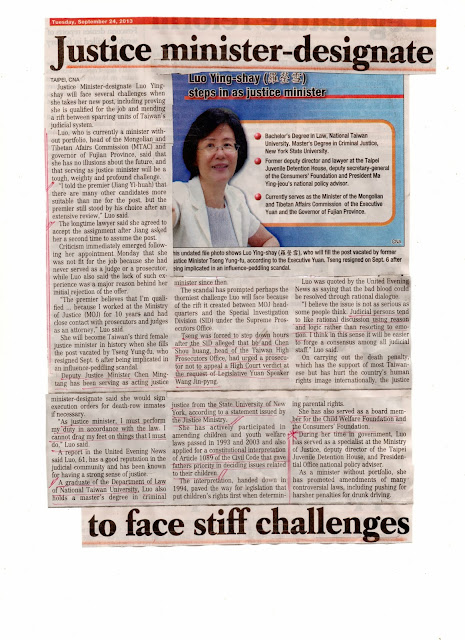
Rule of laws and Moral Courage in Taiwan .( The new Justice minister-designate to face stiff challenges. ).


Justice minister-designate to face stiff challenges

If   Men  and  Women  do   not  possess    the   Moral   Courage    , they  have  no  security   whatever   for  the  preservation    of  any   other  .  It  is   the  courage   to  seek  and   to   speak   the  truth  ,  the   courage   to   be  just   ,  the   courage   to   be   honest  ,    the   courage   to   resist  temptation  ,  the   courage  to  do  one's  duty  . 
              I   hope  I  shall  always  possess   firmness  and   virtue  enough   to   maintain  what   I   consider  the   most  enviable  of   all   titles  ,   the  character   of   an   HONEST   MAN.   (  George   Washington   ) ...............
  RULE 
Many organizations and scholars have advocated the rule of law and have taken positions regarding the interpretation of that concept they prefer.

International Commission of Jurists[

edit source]
In 1959, an international gathering of over 185 judges, lawyers, and law professors from 53 countries, meeting in 
New Delhi and speaking as the International Commission of Jurists, made a declaration as to the fundamental principle of the rule of law. This was theDeclaration of Delhi. They declared that the rule of law implies certain rights and freedoms, that it implies an independent judiciary, and that it implies social, economic and cultural conditions conducive to human dignity. The Declaration of Delhi did not, however, suggest that the rule of law requires legislative power to be subject to judicial review.[47]

United Nations[

edit source]
The 
Secretary-General of the United Nations defines the rule of law as:[48]
a principle of governance in which all persons, institutions and entities, public and private, including the State itself, are accountable to laws that are publicly promulgated, equally enforced and independently adjudicated, and which are consistent with international human rights norms and standards. It requires, as well, measures to ensure adherence to the principles of supremacy of law, equality before the law, 
accountability to the law, fairness in the application of the law, separation of powers, participation in decision-making, legal certainty, avoidance of arbitrariness and procedural and legal transparency.
The General Assembly has considered rule of law as an agenda item since 1992, with renewed interest since 2006 and has adopted resolutions at its last three sessions.
[49] The Security Council has held a number of thematic debates on the rule of law,[50] and adopted resolutions emphasizing the importance of these issues in the context of women, peace and security,[51] children in armed conflict,[52] and the protection of civilians in armed conflict.[53] The Peacebuilding Commission has also regularly addressed rule of law issues with respect to countries on its agenda.[54] The Vienna Declaration and Programme of Action also requires the rule of law be included in human rights education.[55]

The International Development Law Organization[

edit source]
The International Development Law Organization (IDLO) enables governments and empowers people to reform laws and strengthen institutions to promote peace, justice, sustainable development and economic opportunity. IDLO works along the spectrum from peace and institution-building to economic recovery in countries emerging from conflict and striving towards democracy. It supports emerging economies and middle-income countries to strengthen their legal capacity and rule of law framework for sustainable development and economic opportunity. The International Development Law Organization is the only inter-governmental organization with an exclusive mandate to promote the rule of law, IDLO works to make institutions of law and justice work for people.

International Bar Association[

edit source]
The Council of the 
International Bar Association passed a resolution in 2009 endorsing a substantive or "thick" definition of the rule of law:[56]
An independent, impartial judiciary; the presumption of innocence; the right to a fair and public trial without undue delay; a rational and proportionate approach to punishment; a strong and independent legal profession; strict protection of confidential communications between lawyer and client; equality of all before the law; these are all fundamental principles of the Rule of Law. Accordingly, arbitrary arrests; secret trials; indefinite detention without trial; cruel or degrading treatment or punishment; intimidation or corruption in the electoral process, are all unacceptable. The Rule of Law is the foundation of a civilised society. It establishes a transparent process accessible and equal to all. It ensures adherence to principles that both liberate and protect. The IBA calls upon all countries to respect these fundamental principles. It also calls upon its members to speak out in support of the Rule of Law within their respective communities.

World Justice Project[

edit source]
As used by the 
World Justice Project, a non-profit organization committed to advancing the rule of law around the world, the rule of law refers to a rules-based system in which the following four universal principles are upheld:[57]
1. The government and its officials and agents are accountable under the law;
2. The laws are clear, publicized, stable, fair, and protect fundamental rights, including the security of persons and property;
3. The process by which the laws are enacted, administered, and enforced is accessible, fair, and efficient;
4. Access to justice is provided by competent, independent, and ethical adjudicators, attorneys or representatives, and judicial officers who are of sufficient number, have adequate resources, and reflect the makeup of the communities they serve.
The World Justice Project has developed an Index to measure the extent to which countries adhere to the rule of law in practice. The WJP Rule of Law Index is composed of 9 factors and 52 sub-factors, and covers a variety of dimensions of the rule of law —such as whether government officials are accountable under the law, and whether legal institutions protect fundamental rights and allow ordinary people access to justice.
[58]

Albert Dicey[

edit source]
British jurist 
A. V. Dicey popularized the phrase "rule of law" in 1885.[8][59] Dicey emphasized three aspects of the rule of law :[60]
  1. No one can be punished or made to suffer except for a breach of law proved in an ordinary court.
  2. No one is above the law and everyone is equal before the law regardless of social, economic, or political status.
  3. The rule of law includes the results of judicial decisions determining the rights of private persons.

Joseph Raz[

edit source]
In 1977, the influential political theorist 
Joseph Raz identified several principles that may be associated with the rule of law in some (but not all) societies.[61] Raz's principles encompass the requirements of guiding the individual's behaviour and minimizing the danger that results from the exercise of discretionary power in an arbitrary fashion, and in this last respect he shares common ground with the constitutional theorists A. V. Dicey, Friedrich Hayek and E. P. Thompson. Some of Raz's principles are as follows:
  • That laws should be 
prospective rather than retroactive.
  • Laws should be stable and not changed too frequently, as lack of awareness of the law prevents one from being guided by it.
  • There should be clear rules and procedures for making laws.
  • The 
  • independence of the judiciary has to be guaranteed.
  • The 
  • principles of natural justice should be observed, particularly those concerning the right to a fair hearing.
  • The courts should have the power of 
  • judicial review over the way in which the other principles are implemented.
  • The courts should be accessible; no man may be denied 
  • justice.
  • The 
  • discretion of law enforcement and crime prevention agencies should not be allowed to pervert the law.
    According to Raz, the validity of these principles depends upon the particular circumstances of different societies, whereas the rule of law generally "is not to be confused with democracy, justice, equality (before the law or otherwise), human rights of any kind or respect for persons or for the dignity of man".
    [61]

    In relation to economics[

    edit source]
    One important aspect of the rule-of-law initiatives is the study and analysis of the rule of law’s impact on economic development. The rule-of-law movement cannot be fully successful in transitional and developing countries without an answer to the question: does the rule of law matter for economic development or not?
    [62] Constitutional economics is the study of the compatibility of economic and financial decisions within existing constitutional law frameworks, and such a framework includes government spending on the judiciary, which, in many transitional and developing countries, is completely controlled by the executive. It is useful to distinguish between the two methods of corruption of the judiciary: corruption by the executive branch, in contrast to corruption by private actors.
    The standards of constitutional economics can be used during annual 
    budget process, and if that budget planning is transparent then the rule of law may benefit. The availability of an effective court system, to be used by the civil society in situations of unfair government spending and executive impoundment of previously authorized appropriations, is a key element for the success of the rule-of-law endeavor.[63]
    The Rule of Law is especially important as an influence on the economic development in developing and transitional countries. To date, the term “rule of law” has been used primarily in the English-speaking countries, and it is not yet fully clarified even with regard to such well-established democracies as, for instance, Sweden, Denmark, France, Germany, or Japan. A common language between lawyers of common law and civil law countries as well as between legal communities of developed and developing countries is critically important for research of links between the rule of law and real economy.
    [64]
    The modern economist 
    F. A. Hayek analyzed how the Rule of Law might be beneficial to the free market. Hayek proposed that under the Rule of Law individuals would be able to make wise investments and future plans with some confidence in a successful return on investment when he stated: "under the Rule of Law the government is prevented from stultifying individual efforts by ad hoc action. Within the known rules of the game the individual is free to pursue his personal ends and desires, certain that the powers of government will not be used deliberately to frustrate his efforts."[65] Hayek defined the Rule of Law as the opposite of arbitrary government: "The distinction we have drawn before between the creation of a permanent framework of laws within which the productive activity is guided by individual decisions and the direction of economic activity by a central authority is thus really a particular case of the more general distinction between the Rule of Law and arbitrary government. Under the first the government confines itself to fixing rules determining the conditions under which the available resources may be used, leaving to the individuals the decision for what ends they are to be used. Under the second the government directs the use of the means of production to particular ends. The first type of rules can be made in advance, in the shape of formal rules which do not aim at the wants and needs of particular people. They are intended to be merely instrumental in the pursuit of people's various individual ends. And they are, or ought to be, intended for such long periods that it is impossible to know whether they will assist particular people more than others. They could almost be described as a kind of instrument of production, helping people to predict the behavior of those with whom they must collaborate, rather than as efforts toward the satisfaction of particular needs."[66]